

Sustainability
Environment and Energy
Our Approach to Biodiversity
The H.U. Group’s business activities are dependent on forests, soil, water, the atmosphere, biological resources and other ecological services generated by natural capital. However, the burden that our business activities places on the environment considerably impacts natural capital.
For this reason and based on the H.U. Group’s understanding that contributing to the maintenance and conservation of biodiversity is an important issue, the relationship between biodiversity and the H.U. Group’s business activities is summarized in "Biodiversity Relationship Diagram" to make it easier to understand what is happening in the value chain.
The H.U. Group promotes activities for achieving nature positivity (nature reconstruction) to reduce its negative impact on biodiversity and to increase its positive impact.
Governance
Under our Promotion Structure for Sustainability, our biodiversity initiatives are formulated and executed by the “Environment and Energy Subcommittee”, which is managed by the Division Head in charge of Human Resources Management & General Affairs. Additionally, important matters such as goal setting are discussed at the “H.U. Group Sustainability Committee” and reported to the Board of Directors as appropriate.
(Please refer to Promotion Structure for Sustainability for more information on our Promotion Structure for Sustainability. )
(Please refer to Management for more information on the system of the Environment and Energy Subcommittee. )
Strategy
In order to understand the relationship between our business and biodiversity, the H.U. Group has created a "Biodiversity Relationship Diagram" for our main LTS and IVD businesses. Water resources and climate change were highlighted as common major factors that affect "dependence" or "impact." In addition to climate change, we believe that initiatives regarding water resources will lead to the conservation of biodiversity, so we focused on water resources to identify risks and opportunities.
- Biodiversity Relationship Diagram
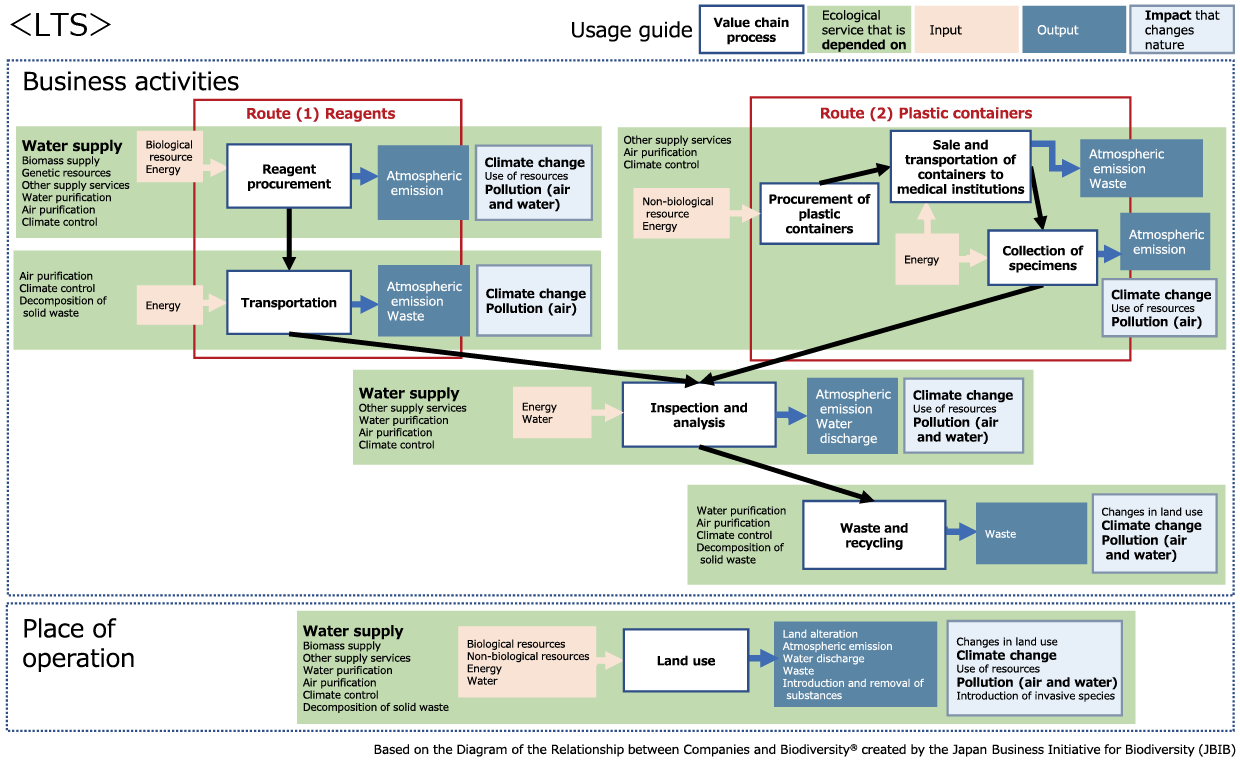
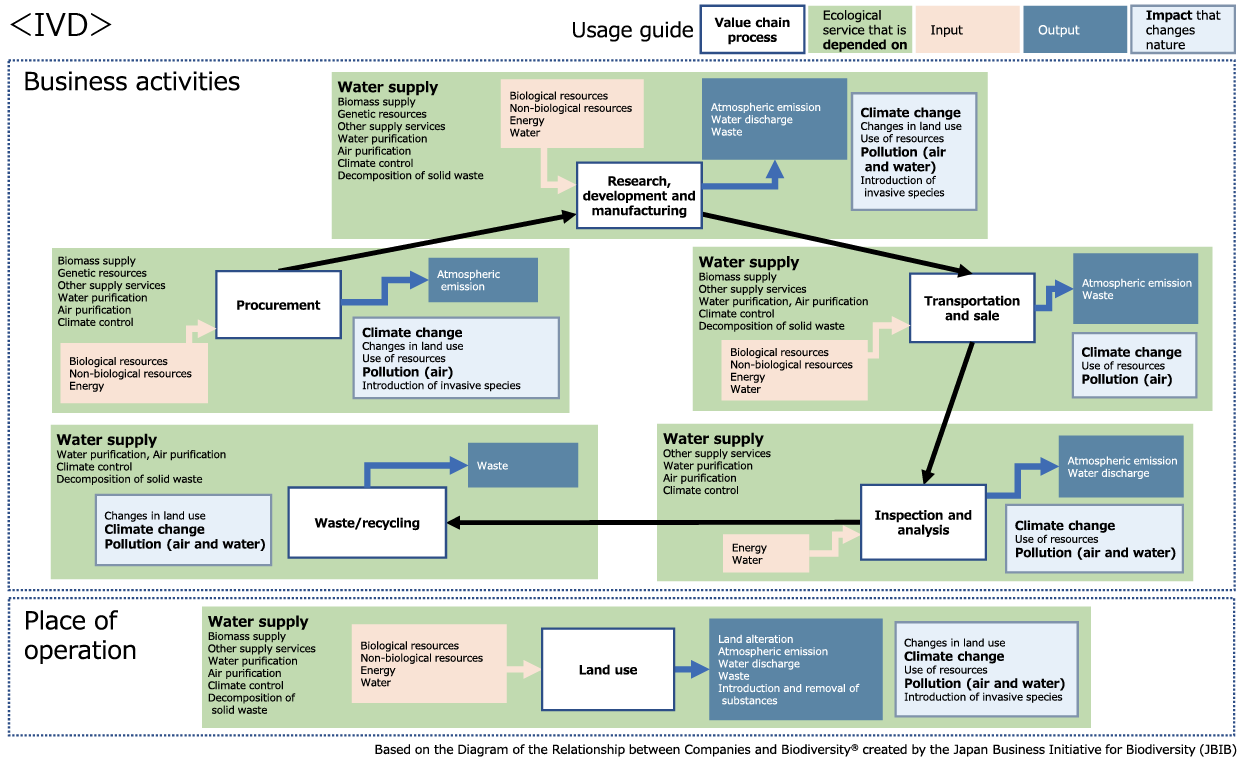
- Identification of risks and opportunities
■Risks related to water
| Risk category | Contents of risk | Measures | |
|---|---|---|---|
| Physical risks |
|
|
|
| Transition risks |
|
|
|
■Opportunities related to water
| Opportunity category | Contents of opportunity | Measures | |
|---|---|---|---|
| Business performance opportunities |
|
|
|
Impact and management of risks
The identified water risks, opportunities, and measures are being managed by the Environment and Energy Subcommittee under the Promotion Structure for Sustainability and will be reviewed as necessary. In addition, factors that may have a significant impact on finances and business continuity are shared with the Risk Management Committee to manage such risks. (Please refer to this link for more information on Business Risks.)
Metrics and targets
In addition to climate change, which is expected to have a significant impact on our business, we recognize water as a key issue and set targets as below and will work to protect water resources.
In addition to climate change, which is expected to have a significant impact on our business, we recognize water as a key issue and set targets as below and will work to protect water resources.
| Non-financial targets(FY2025 - FY2029) | Reduction of water consumption per unit at H.U. Bioness Complex: 5% (compared to FY2024) |
|---|
Initiatives
- Initiatives to Protect Water Resources
The use of tap water and groundwater is essential for the business activities of the H.U. Group. Therefore, we understand that the reduction of the consumption of water, a limited natural resource, is an extremely important
management issue.
Above all, problems in many parts of the world such as the depletion of water resources, degraded water quality, and flooding are seriously affecting the global environment. Partly reflecting this, the H.U. Group is striving
to reduce water consumption and ensure the appropriate treatment and quality control of wastewater treatment to protect water resources, which constitute a part of our efforts to establish a recycling-oriented society, one of
the material issues of the Group in the area of the environment.
| Main businesses | Main purpose of water use related to the business |
|---|---|
| Lab testing and related services | Adjustment and dilution of reagents and cleaning of analytical equipment |
| In-vitro diagnostics | Production of reagents |
| Healthcare-related services | Cleaning of medical instruments |
- Understanding and Addressing Water Risks
We identify water risks at our domestic and overseas production sites based on Overall Water Risk, an indicator used by AQUEDUCT released by the Water Resources Institute (WRI). We have thus confirmed that none of our sites is operating in a region with "Extremely High" or "High" water stress. If a site with a high level of water risk is identified in the future, we will take appropriate measures such as the reduction of water consumption according to the details of the risk and societal conditions.
Results
Please refer to ESG Performance Data.
-
Sustainability Subcommittee