

Sustainability
Environment and Energy
Information Disclosure in line with TCFD Recommendations
In November 2021, the H.U. Group announced its support for the recommendations of the Task Force on Climate-related Financial Disclosures (TCFD) and, based on the TCFD framework, assesses and manages climate-related risks and opportunities and discloses relevant information.
Governance
The H.U. Group‘s Sustainability Committee, with the CEO as its chair, deliberates on climate change issues and implements CO2 reduction targets and manages progress. The Division Head in charge of Human Resources Management & General Affairs serves as chair of the Environment and Energy Subcommittee. Based on this subcommittee's decisions, the division promotes measures against climate change.
(Please refer to Promotion Structure for Sustainability for more information on our Promotion Structure for Sustainability. )
(Please refer to Management for more information on the system of the Environment and Energy Subcommittee. )
Strategy
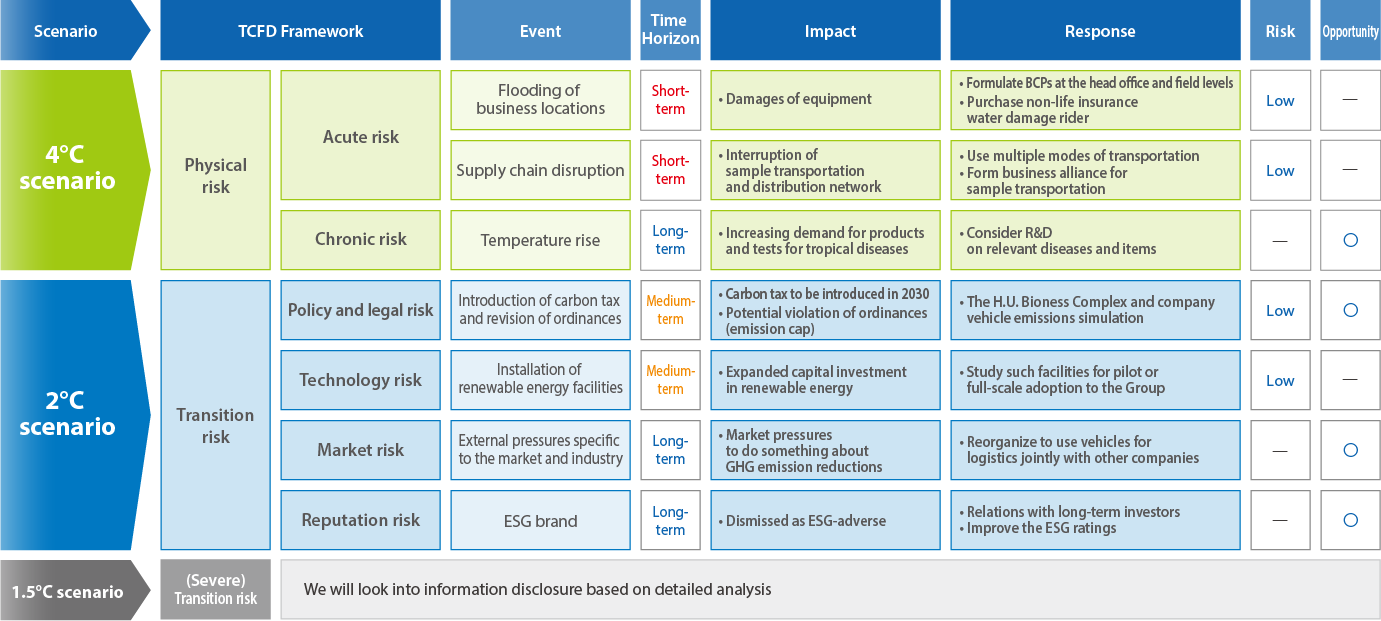
Through the H.U. Group Sustainability Committee, risks and opportunities are identified and impacts are anticipated.
Response to risks / opportunities
highly uncertain climate change.
In considering our risk and opportunity responses, we have deepened our understanding of the world, where transition risks increase (1.5℃ and 2℃) and where physical risks increase (4℃), and sorted out events that could take
place under each scenario. To prepare for these potential events, we have set timelines of “short term: 1 year”, “medium term: 5 years”, and “long term: 10 years”, organized the potential business impact and our response
measures, and analyzed business risks and opportunities.
Risk Management
The H.U. Group Risk Management Committee selects natural disaster risk, including the impact of climate change, as one of the significant risks.
(Please refer to this link for more information on Business Risks.)
Metrics and targets
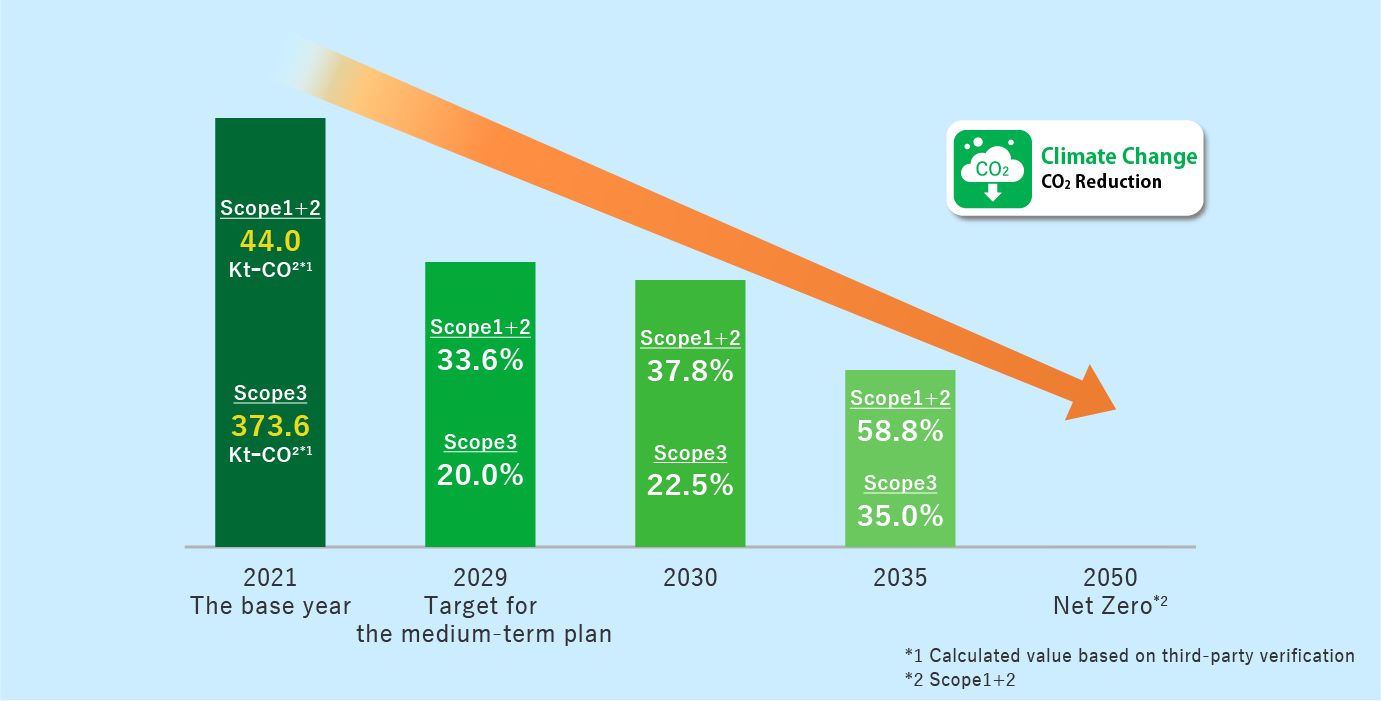
The H.U. Group has included climate change as a component of material issue ”Mitigation of environmental impacts” based on the Paris Agreement. We have set long-term targets of achieving net zero CO2 emissions by 2050. In addition, we have set medium-term targets to be achieved by 2030 and 2035.
In FY2023, we have revised our targets upward to be consistent with the requirements of the Paris Agreement.
Long-Term Environmental Goals (CO2 Reduction)
Initiatives
Response to climate change
The H.U. Group regards climate change as an important issue, has set Long-Term Environmental Goals, and aims to achieve "net zero CO2 emissions by 2050." CO2 is the Group's primary target among all the greenhouse gases, and we are continuously promoting the following energy conservation measures to reduce emissions.
Greenhouse gas (GHG) emission reduction by scope
<Scope1>
・To minimize direct emissions from our business activities, we are working to reduce emissions through greater operational efficiency and the appropriate operation of facilities and vehicles. We are also considering switching to non-fossil-fuel vehicles, such as EVs and FCVs.
<Scope2>
・ We are engaged in energy-saving activities such as the introduction of high-efficiency equipment, conversion to LED lighting, restructuring of laboratory systems, and the consolidation and closure of business sites, as well as the procurement of renewable energy.
<Scope3>
・For products in our in vitro diagnostics business, we are working to discontinue the use of plastic components in packaging and reduce their weight. For details of these initiatives, please see "Recycling-oriented Society".
・One of our Group companies has established an on-site system for treating some infectious waste, thereby shortening the transportation distance and treatment time associated with off-site treatment and contributing to reductions in annual CO₂ emissions.
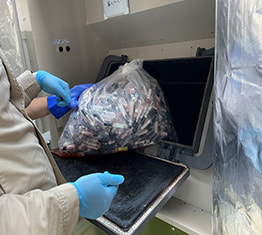
Before treatment:
Infectious waste
(classified as specially controlled industrial waste)
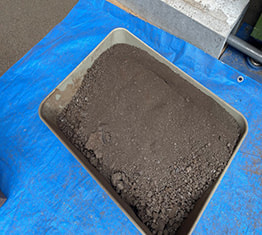
After treatment:
Organic sludge
(classified as industrial waste)
Adaptation to climate change
We are building a business continuity structure based on our social mission not to stop medical testing operations, assuming an event in which a physical risk such as a natural disaster impacts management resources and causes business interruptions.
- Relocation and consolidation of business bases in consideration of water disasters
- Securing generators assuming a certain infrastructure outage
- Securing water and sewage storage facilities
Environmental Communication
The H.U. Group strives for two-way communication with stakeholders through active disclosure of information on environmental management and dialogue with stakeholders.

JAPAN CLIMATE INITIATIVE (*)
In addition to supporting the Japanese government's stance and policy of creating a decarbonized society, in April 2020 we joined the Japan Climate Change Initiative (JCI) by agreeing to its declaration of “Joining the front
line of the global push for decarbonization from Japan.” In October 2021 we joined the JCI Race To Zero Circle, in order to participate in the Race to Zero promoted by the secretariat of the United Nations Framework
Convention on Climate Change (UNFCCC).
In addition to the above, we will continue to strengthen our efforts to address policies and regulations relating to the global environment, on issues such as carbon neutrality and decarbonization, through active
participation in various initiatives including the TCFD Consortium and the United Nations Global Compact Environmental Management Subcommittee.
- A network organization to strengthen information dissemination and exchange of opinions among companies, local governments, NGOs, and other actors that are actively engaged in taking climate action in Japan.
- Expression of Support for an Initiative Mitigating the Impact of Climate Change
We will formulate and promote plans to mitigate the impact of climate change and proactively lobby the government to introduce relevant public policies and regulations.
<Our efforts and proposals to the Japanese government and public policies through JCI messages>
<Endorsement of an International Joint Statement Coordinated by the We Mean Business Coalition and Other Organizations>
Regarding participation in and review of industry associations, we are considering consistency with our environmental policy and business activities, and periodically check for any major inconsistencies or deviations. If we determine that there is a large discrepancy, we will consider withdrawing from the association.
Results
Please refer to ESG Performance Data.
-
Sustainability Subcommittee